
-
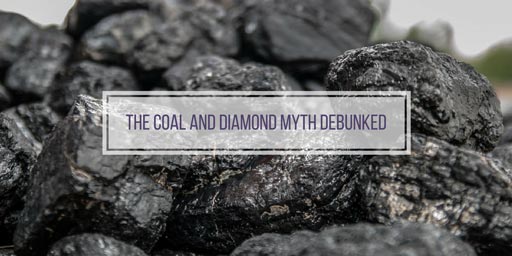
Coal and diamonds share a common foundation, or base - the element carbon - represented by C in the periodic table.
-
Coal forms from accumulated plant matter over geological time. It contains carbon, but its origin is different from that of most natural diamonds.
-
Natural diamonds are crystalline carbon. Most gem diamonds formed deep in Earth’s mantle under high pressure and temperature.
The familiar story says that pressure turns coal into diamonds. It is a poor explanation for natural gem diamonds: coal is found in Earth’s crust, while most gem diamonds formed much deeper in the mantle. GIA’s account of diamond formation explains why direct conversion of coal is not the usual process.
However, there is a slight possibility that coal may have played a part in some of the diamond formation processes. But, it’s not likely as you will read. For the natural gem diamonds described below, coal is not the usual carbon source.
Is Superman to blame for the myth that diamonds come from coal?
Where did the common belief that diamonds are made out of coal come from in the first place? Thank Superman for this lie.
Throughout the decades, Superman TV shows, movies, and comic books featured the fabled Kryptonian taking lumps of coal and pressing them in the palm of his hands to render sparkling diamonds. Interesting twist in the Superman series, but this fairy tale would never actually work in real life, and has led thousands to make a connection between the origins of diamond deposits as coal.
What is the real origin of diamonds?
Coal deposits and diamonds have different geological histories; the more important difference is where they form. Interestingly, this “diamonds from coal” myth is so widespread, it’s even taught in some classrooms today! While there may be a slight crossing over, coal has rarely played any role in the diamond creation process.
Another difference between the formation of diamond verses the formation of coal, is that coal manifests as horizontal, or close to horizontal ,rock units composed of sedimentary rocks. In contrast, diamonds’ source rocks consist of pipes that are vertical and filled with igneous rocks.
What are the diamond formation processes?
Four processes exist that are thought to be responsible for all naturally-occurring diamonds on Earth. Mantle formation accounts for most gem diamonds, while other settings can produce much smaller diamonds. Regardless, coal is rarely involved in any of these four processes. Let’s take a deeper look at these processes.
1. Mantle formation of diamonds
Most natural gem diamonds formed in Earth’s mantle and later reached the surface in volcanic rock. In order for natural diamonds to occur, the right conditions must be present, which includes extremely high temperatures and pressure. Therefore, diamond formation must occur approximately 90 miles below the surface where temperatures are at least a minimum of 2000 degrees Fahrenheit or 1050 degrees Celsius. This is the main source of the natural gem diamonds people encounter in jewelry.
Would coal be involved in this process? No. Because coal is rarely found more than two miles below the surface, it’s very unlikely.
2. Subduction zone diamond formation
Tectonic plates are thought to be responsible for the formation of tiny diamonds that have been found in rocks. These little diamonds were subducted deep in the mantle, then brought to the surface by plate movement.
Is coal involved in this process? While coal is a possible source of carbon in this particular process, the oceanic plates are more likely for subduction than continental plates due to their higher density.
3. Diamond formation at impact sites
From the beginning of the Earth, asteroids have hit the surface repeatedly. During the impact, extreme pressures and temperatures are created which can lead to the formation of very little diamonds. In fact, tiny diamonds have been discovered at asteroid impact sites.
Coal could potentially be present in the area of impact, however the carbon source could also be other carbon-bearing rocks such as limestones, dolomites, and marbles.
4. Formation in space
As discovered by NASA researchers, meteorites contain numerous nanodiamonds that are much too small to be used as gems or abrasives.
Coal would certainly not be involved in this creation process that occurs outside of the Earth.