Table of contents:
- Stages of grief chart
- The stage of denial
- Pain phase
- Anger phase
- The bargaining phase
- Guilt phase
- How memorial diamonds help
Stages of grief are not a fixed sequence
People sometimes use the stages of grief to name feelings after a loss. The American Psychological Association describes this as a hypothetical model, not a required path through bereavement. You may recognize some of the feelings below, none of them, or several at once.
When we suffer from the death of a loved one, we all go through similar experiences. It doesn’t matter the order in which we go through the stages of loss, or how long each stage lasts. People do not all experience the same feelings after a loss.
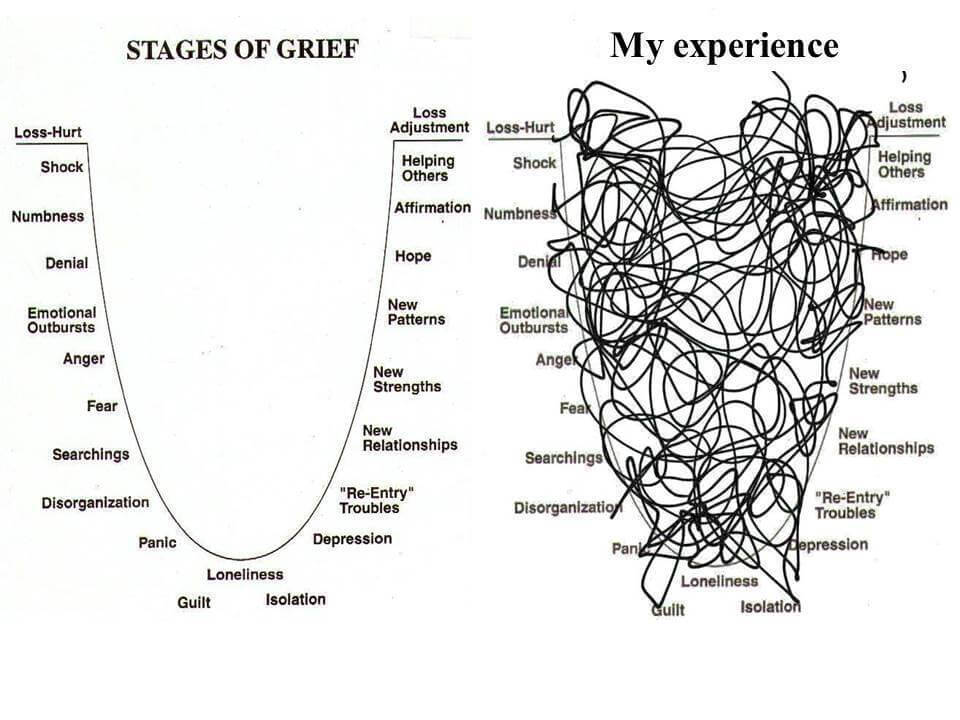
The Twitter account @MindMatters explains that the stages of loss seem to take a person from a loss-hurt phase to a loss-adjustment phase as pictured below.
One of the most important things to remember when going through the grieving process is that it doesn’t matter which stage of grief you’re experiencing when you think about your loved one. It’s not as simple as waking up one morning and realizing you’re in the denial stage and next week recognizing that you’ve moved onto bargaining.
There isn’t a linear timeline in grief. Each experience of loss is as individual as the loved one being mourned. The sections below describe common feelings, not steps that anyone needs to complete.
Coping with loss can be difficult when going through denial
Some psychologists believe that denial is the first stage of grief. They attribute this to the idea that everyone believes death is something that happens to other people — it’s not something that will happen to you.
Denial acts as an emotional protector or a defense mechanism, there for you until you’re ready to begin processing your pain. Some people choose a keepsake as a reminder of the person they miss. A remembrance diamond, which can be created before your loved one has passed away, lets you share the creation with them so they can see how beautiful it is.
This means that even if your mind is finding it difficult to process the stages of grief, you can take comfort in your loved one being with you as you experience the emotions commonly labelled as the grieving process.
Pain is a common part of the grieving process and can feel overwhelming
Pain often occurs when you begin to process the emotions you’ve been suppressing after the loss of a loved one. Some experts claim that accepting pain is an indication that you’re accepting grief.
A remembrance diamond can be one physical reminder of someone you miss. It can be difficult to know what to do with your loved one’s ashes after you bring them home.
Instead of leaving them sitting in an urn gathering dust, transforming them into cremation diamonds means that your loved one can accompany you wherever you go. A diamond may be meaningful to some families, while others prefer to keep or scatter the ashes.
Going through anger stages is normal
Anger can be part of grief, but it does not happen to everyone. If belongings bring up difficult feelings, you can take time before deciding what to keep, share or give away.
A memorial diamond is something that can be kept forever and will always carry a special meaning. If it makes things easier you can create the diamond and put it to one side until you’ve finished going through the anger stages. When you’re ready to embrace the memory of your loved one, you can bring the diamond back out into the open.
Bargaining stage of grief
It’s common for people to negotiate with themselves and their spiritual side in an attempt to understand what’s happened. This is often termed as the bargaining phase of grief.
If someone wants to make memorial plans in advance, they can talk with family about those wishes. A diamond is only one possible choice.
With Heart In Diamond, you can design your own cremation diamond in advance. After you pass away, your loved ones can complete the process according to your wishes. This allows you to leave a precious legacy for your loved ones they’ll treasure forever.
Feeling guilty is normal
Guilt is another feeling that some people describe after a loss. Guilty feelings are thought to arise due to unresolved issues with the person who has passed away. It’s common to feel guilty when you think about past fights or negative encounters with your lost loved one.
A keepsake may bring back a happy memory, but it cannot remove guilt or settle a difficult relationship. The main purpose of a cremation diamond is to remind you that the person you loved, cared and loved you deeply in return and that no fight or disagreement will ever change that.
Acceptance does not follow a schedule
Turning your loved one’s ashes into diamonds lets you solidify their place in your life and heart for all eternity. Some people find a physical reminder meaningful; others do not.
Acceptance takes different forms, such as accepting that your loved one has passed on, accepting that you have been left behind or accepting that a new stage of your life is beginning. Cremation diamonds are an acknowledgement of your wish to keep your loved one with you forever.
It’s never easy to say goodbye and the process of deciding what to do with your loved one’s ashes can be equally difficult. It’s normal for your emotions to feel overwhelming and simply be unable to decide what to do with the remains of someone you shared such a strong connection with.
Even though we’ve discussed the various emotions of grief in a linear manner, mourning the loss of a loved one and coming to terms with their death is never easy and rarely simple. It’s common to go through many different emotions, experiencing different things at different times. Even much later, when you think you’ve come to terms with things, it’s normal for grief to return.
If you are making decisions about ashes, take the time you need and discuss the options with the people involved.
Twitter handle @TabithaHealth provides a brief illustration of how grief can be processed in five stages instead of 12. Regardless of how many stages there are, or what order they’re experienced in, what’s important is to grieve in a way that’s right for you.
Regardless of the form your grief takes, a memorial diamond can help with processing the loss of your loved one by keeping them close to you always. Counsellor Kay Bruner provides a humorous look on how differently grief can be processed by each person.